How to compare subcontractor quotes against a pricing schedule
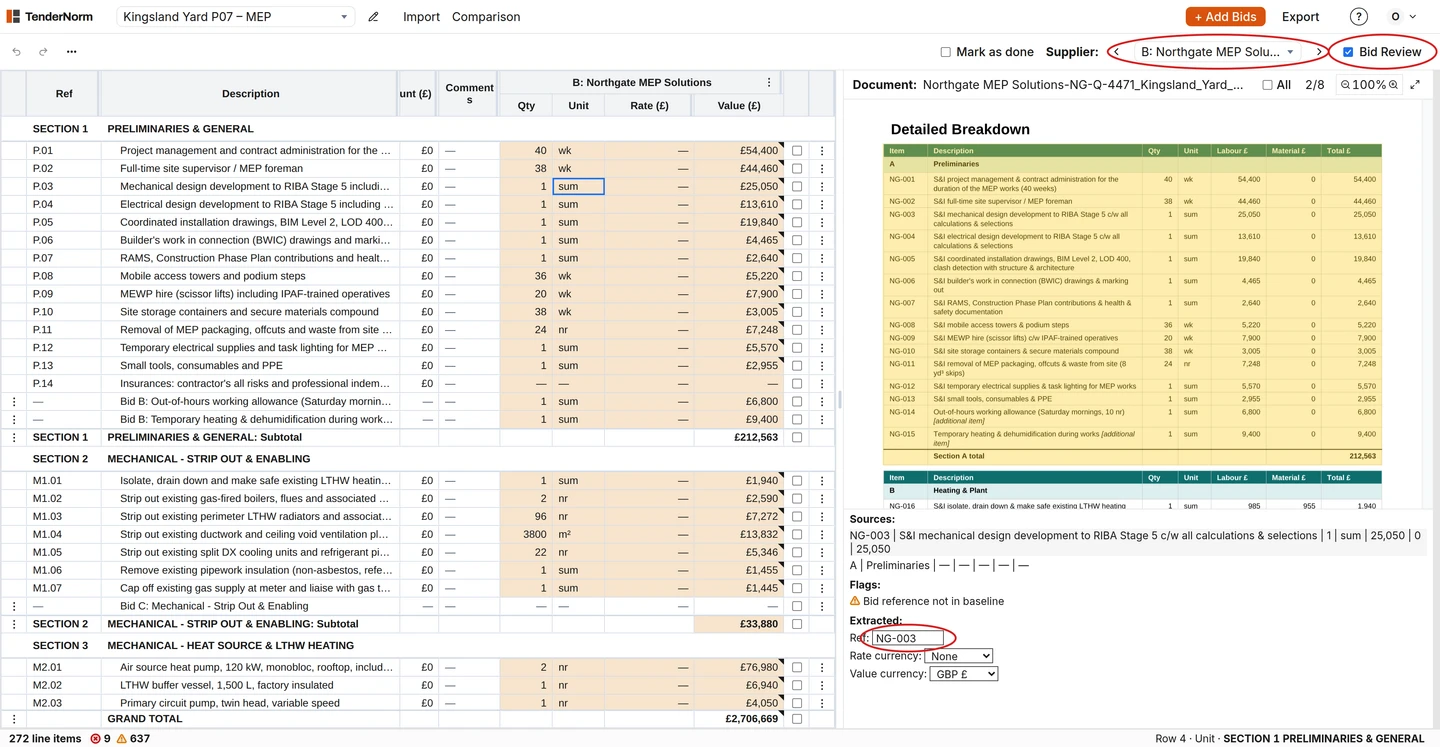
Put every quote on the pricing schedule that was sent out, item by item, so each supplier's price sits on the same row. Then check each quote's sums, look for items they left out or measured differently, and read their exclusions before comparing totals.
Why quotes don't line up
- Suppliers use their own templates, numbering and descriptions.
- Some price lump sums per section; others give rates for every item.
- Quantities are often the supplier's own measure, not the pricing schedule's.
- Exclusions and conditions sit in a covering letter, not next to the price.
Step by step
- Use the pricing schedule as the rows. Don't build the comparison around one supplier's layout.
- Place each supplier's prices on the pricing schedule's items. Match by reference where they kept the pricing schedule's, and by description where they didn't.
- Keep their extras and alternatives on separate rows, marked as not in their total.
- Check quantity × rate, the section subtotals and the total for each quote.
- Flag items with no price, and items priced at a different quantity or unit.
- Read every exclusion and assumption, and note which items they affect.
- Compare section by section first, then the totals.
What to look for
- A section well below the others
- Usually missing scope, not a better price. Check the items in it first.
- Sum instead of a quantity
- The supplier priced a lump sum where the pricing schedule gives a quantity. Their price may not cover the full quantity.
- Supply only
- No installation. Common on M&E equipment quotes, and easy to miss.
- Builder's work excluded
- Holes, fixings and making good left for someone else to price.
Questions
- Do suppliers need to use a set template?
- No. Asking helps, but most won't. A good comparison works from the formats they actually send.
- How many quotes should be compared?
- Three to five compliant quotes per package is typical. Fewer gives little competition; more adds checking time.